Best Activities for 6–12 Month Olds: Play That Builds Development
Six months is a developmental inflection point.
Before six months, your baby was primarily a receiver of sensory input. After six months, they become an agent — reaching, grasping, choosing, dropping, searching, problem-solving. Play at this stage isn’t just entertainment. It’s the primary mechanism through which their brain gets built.
These are the activities that do the most developmental work between 6 and 12 months — explained by what they develop, not just what they are.
Object Permanence: the concept that changes everything
Before 6 months, when an object disappears from sight, a baby acts as though it no longer exists. They don’t search for it. They move on.
Around 6–8 months, object permanence begins to emerge: the understanding that things continue to exist even when they can’t be seen. This is one of the most fundamental cognitive milestones of infancy, and it transforms play completely.
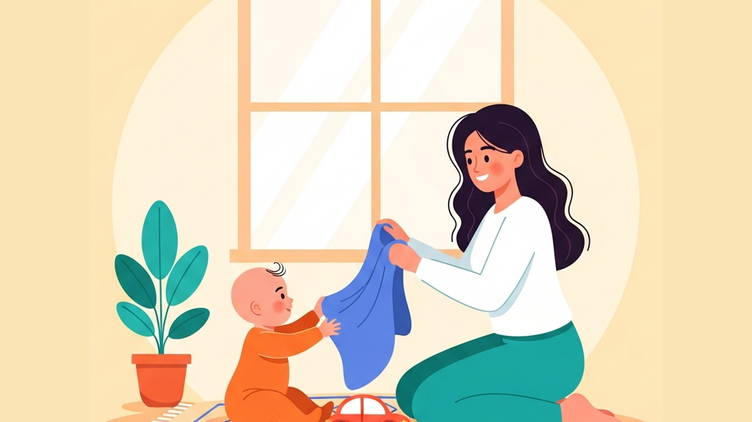
Hidden Toy
The simplest object permanence game:
- Let your baby watch you hide a toy under a cloth.
- Ask “Where did it go?”
- Wait and watch. Do they search?
In early object permanence, babies search where they last saw an object — even if you move it right in front of them. Over several months, their searches become more sophisticated. By 12 months, most babies will search multiple locations.
You can make this progressively harder:
- One cloth → two cloths → behind your back
- Object stays visible → partially hidden → fully hidden → moved while hidden
Magic Cloth Box
Fill a box or container with fabric scraps of different textures — velvet, mesh, terry cloth, silk, denim. Let your baby pull them out, feel them, drop them into the box, and pull them out again.
This develops:
- Object permanence (pulling a hidden cloth out of a box)
- Grip strength and fine motor control
- Tactile discrimination — learning that surfaces feel different from each other
- The concept of container (things go in, things come out)
Cause and effect: the foundation of scientific thinking
Between 6 and 12 months, babies become fascinated by cause-and-effect relationships. They drop something — it falls. They hit something — it makes a sound. They cry — someone comes.
Activities that deliberately play with cause-and-effect do more cognitive work than almost anything else at this age.
Spoon Drumming
Give your baby a wooden spoon and let them bang it against:
- A metal bowl
- A plastic container
- A cardboard box
- A pillow
Different materials make completely different sounds. Your baby is learning the relationship between force, material, and sound — which is essentially physics. Let them discover it themselves without directing them.
Drop and Fetch
This is the activity babies invent on their own, and it drives parents crazy: repeatedly dropping things off a high chair tray.
Here’s the thing — this is intentional research. Your baby is testing:
- Does it always fall?
- Does it fall the same way every time?
- What happens if I do it again?
- What happens to you when I do this?
Instead of stopping it, use it. Vary what they’re dropping. Put different materials on the tray — a ball, a cloth, a spoon. Watch as they observe the different ways things fall.
Motor development: sitting, standing, crawling
Soft Block Tower
Stack three fabric or foam blocks in front of your baby. Let them knock it over. Stack it again.
This develops:
- Gross motor control (the swipe or push)
- Spatial reasoning (understanding that the tower is taller than the blocks)
- Cause-and-effect (my arm movement topples the whole structure)
- Anticipatory joy — by the fourth or fifth repetition, babies laugh before they’ve even knocked the tower over, because they know what’s coming
Tunnel Crawling
At around 8–10 months, most babies are crawling. A fabric tunnel (or a row of chairs with a blanket draped over them) gives crawling a purpose — and teaches spatial reasoning about their own body size.
Even babies who aren’t crawling yet benefit from being encouraged to navigate the tunnel on their belly — it strengthens the same arm and core muscles.
Standing Support Activities
Once your baby can pull to standing, give them something to do there:
- A low table with interesting objects to explore standing up
- A push toy to hold and lean on while taking steps
Standing activities reinforce leg strength and build toward independent walking without rushing it.
Language: from babble to understanding
Narrate everything
This is the highest-impact language activity for this age group, and it requires no equipment. It’s called “sports-casting” by speech language pathologists: simply describe what you and your baby are doing, moment by moment.
“You’re picking up the red block. Now you’re putting it in your mouth — out comes the block. Now you’re looking at me.”
Research on language development consistently shows that the sheer volume of words a child hears in the first three years is the strongest predictor of vocabulary at school age. You can’t overdo narration.
Name-and-point games
Point to things in your environment and name them. Your nose. Their nose. The dog. The cup. The window.
At 6–9 months, babies are mapping words to concepts — building the vocabulary that will eventually become speech. The understanding comes months before the production.
Peek-a-boo
This is one of the most developmentally rich activities for this age, and it’s fun:
- Cover your face with your hands or a cloth.
- Say “Where’s [name]?”
- Reveal with “Peek-a-boo!”
Peek-a-boo combines object permanence (where did the face go?), anticipatory timing (the baby learns to expect the reveal), and social reciprocity (taking turns). By 9–10 months, babies begin initiating it themselves.
Auditory and musical development
Sound Discovery
Give your baby a set of containers — a metal tin, a plastic cup, a fabric bag — all containing different things: rice, bells, cotton.
Let them shake and discover the different sounds. This develops auditory discrimination — the ability to distinguish between sounds, which is a prerequisite for language processing.
Rhythm activities
Clap your hands in a simple rhythm. Then take your baby’s hands and clap them together in the same rhythm. Alternate.
Rhythm perception is a musical skill, but it also transfers to language — because language is rhythmic. Languages have stress patterns, syllable timing, and cadence. Babies who are exposed to rhythm early show stronger language development.
A note on screen time
At 6–12 months, the American Academy of Pediatrics recommends avoiding screen time except for video chatting with family.
This isn’t about moral judgment — it’s about opportunity cost. Every minute in front of a screen is a minute not spent in the kind of reciprocal, cause-and-effect, sensory-rich play described above. Passive video does not build the same neural architecture. The quality of interaction with a caregiver cannot be replicated by a screen.
All of these activities are built into Muchi, with the right one selected for your baby’s exact age in months, complete with step-by-step instructions and a pediatrician’s note on what’s being developed.