Baby Massage: Benefits, Techniques, and When to Start
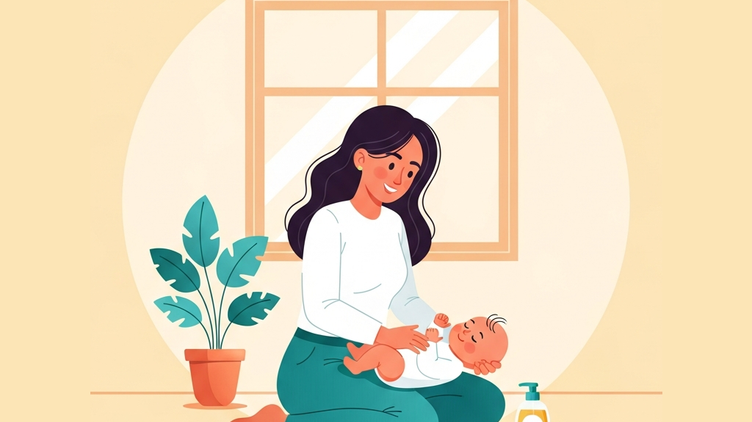
Baby massage has one of the strongest evidence bases of any parenting intervention. Studies going back to the 1990s show measurable improvements in weight gain, sleep quality, cortisol regulation, and parent-baby attachment — across both premature and full-term infants.
And yet most parents either don’t know about it, or feel awkward doing it.
This guide covers the why, the how, and the when — plus the mistakes that make babies fuss and the adjustments that make them melt.
Why baby massage works
Three things happen during a good massage:
1. Cortisol drops. Cortisol is the primary stress hormone. In newborns, it’s elevated by cold, hunger, unfamiliar environments, and anything that breaks the sensory continuity of the womb. Skin pressure — applied steadily and warmly — signals safety to the nervous system and suppresses the cortisol response.
2. Oxytocin rises. Oxytocin is the bonding hormone. It rises in your baby during massage — and in you. The physical ritual of daily massage has been shown to reduce maternal anxiety and depression scores in studies of postpartum mothers.
3. The vagal system activates. The vagus nerve is the main pathway of the parasympathetic nervous system — the “calm and rest” mode. Consistent pressure on the skin activates vagal tone, which improves digestion, regulates heart rate, and deepens sleep. This is why massage helps colicky babies — it directly addresses the digestive component of crying.
When to start
You can start gentle massage as early as the first week — once the umbilical cord is healing cleanly and your baby is medically stable.
In the first two weeks, keep massage very light and very short. Your baby’s nervous system is still calibrating to the outside world, and too much input too quickly can backfire.
By 4–6 weeks, most babies are ready for a fuller 10–15 minute routine.
What you need
- Baby oil or unscented lotion. Avoid fragrant products — your baby’s sensory system is heightened, and synthetic fragrances are often irritating. Sunflower oil, coconut oil, or any fragrance-free baby lotion works well.
- A soft blanket or changing mat.
- A warm room. Your baby will be undressed. 24–26°C is comfortable.
- Your full attention. Put the phone away.
Step-by-step technique
Step 1: Ask permission
This sounds odd — your baby can’t say yes — but the principle is real. Before starting, warm your hands and place them gently on your baby’s chest. Watch their response. If they soften and their breathing slows, proceed. If they tense, arch, or start fussing, this isn’t the right moment.
Step 2: Legs first
Start with the legs — they’re the least sensitive area and the easiest for a baby to accept.
- Hold your baby’s ankle with one hand.
- With your other hand, stroke downward from thigh to ankle in one slow, continuous movement.
- Repeat 4–6 times, then switch legs.
Step 3: Feet
- Hold the foot in both hands.
- Use your thumbs to make small circles on the sole, from heel to toes.
- Gently stretch each toe.
Step 4: Arms
- Same technique as the legs — one hand holds the wrist, the other strokes from shoulder to wrist.
- Repeat 4–6 times, then switch.
Step 5: Hands
- Open the fist gently.
- Small thumb circles on the palm.
- Stretch each finger lightly.
Step 6: Chest
- Place both hands flat on the center of the chest.
- Stroke outward toward the shoulders, as if smoothing a page.
- Then stroke downward from chest to belly with gentle, even pressure.
Note: Avoid the abdomen if the umbilical cord hasn’t fully healed.
Step 7: Back
- Turn your baby onto their tummy (if they tolerate it — some young babies don’t).
- Use long, flat strokes from shoulders to bottom.
- Small thumb circles on either side of the spine — never on the spine itself.
Step 8: Face (optional)
- For babies who enjoy it: small circles on the temples, light strokes across the forehead, gentle pressure on the cheeks.
- Skip the face entirely if your baby pulls away — many young babies find facial massage overstimulating.
Building it into a routine
The research on baby massage shows benefits from consistency — not duration. A 10-minute massage done daily outperforms a 30-minute massage done twice a week.
The best time for most families is after bath, before the last feed of the evening. The bath warms and relaxes the body, the massage deepens that relaxation, and the feed caps the session with comfort. For many babies, this sequence becomes a powerful sleep cue within a few weeks.
When massage makes babies fuss
If your baby consistently fusses during massage, it’s usually one of three things:
-
Wrong timing. An overtired or hungry baby won’t tolerate massage. Wait until they’re calm and alert — not just woken up, not about to go down.
-
Too much pressure or too little. Counter-intuitively, very light touch is often more irritating than firmer touch. Light touch activates the tickle response. Try a slightly firmer, more deliberate stroke.
-
Moving too fast. Rushing between body parts doesn’t give the nervous system time to register the input. Slow down by half.
Massage for colic
If your baby has colic — defined as crying for more than 3 hours a day, more than 3 days a week — targeted abdominal massage may help.
The “I Love You” stroke is the most commonly recommended technique:
- “I”: Using two fingers, stroke straight down the baby’s left side (their left, your right when facing them), from ribs to hip.
- “L”: Stroke across the upper abdomen from right to left, then down the left side — making an upside-down “L.”
- “U”: Follow the full curve — up the right side, across, and down the left.
This follows the direction of the colon and helps move trapped gas. Do it gently, 5–6 repetitions, during a calm (not crying) period.
Baby massage is one of 340+ activities in Muchi, complete with a step-by-step guide, teacher notes, and a photo tip for capturing the moment. The app recommends it at the right developmental stage based on your baby’s exact age.