Play-Based Learning: Why Play Is How Babies Learn
A common anxiety in early parenting is the feeling that you should be “doing more” — teaching letters, drilling shapes, using flashcards, following a structured curriculum. This anxiety is understandable, but it’s based on a fundamental misunderstanding of how young children learn.
For children from birth to age 6, play is not a break from learning. Play is learning. It is the primary mechanism through which the developing brain builds the architecture that all subsequent learning depends on.
Here’s why — and what it means practically.
What play actually does to the brain
When a baby reaches for a toy and misses, adjusts, reaches again, and grasps — they’re not just playing. They’re:
- Building sensorimotor feedback loops (the connection between intention, movement, and result)
- Developing proprioception (awareness of their own body in space)
- Learning cause-and-effect (my hand moves to this position → I grasp the object)
- Practicing error correction (I missed → I adjust)
None of this happens through instruction. It happens through doing — through the natural consequence loop that play provides.
The same principle applies at every age and for every domain of development. A toddler stacking blocks and watching the tower fall is learning physics, motor planning, spatial reasoning, and frustration tolerance simultaneously. A three-year-old engaged in pretend play is practicing narrative structure, theory of mind (imagining what the doll is “thinking”), emotional regulation, and language all at once.
Play is the most efficient learning system children have — precisely because it is intrinsically motivated, immediately consequential, and infinitely adjustable.
The four types of play (and what each develops)
Sensorimotor play (birth–2 years)
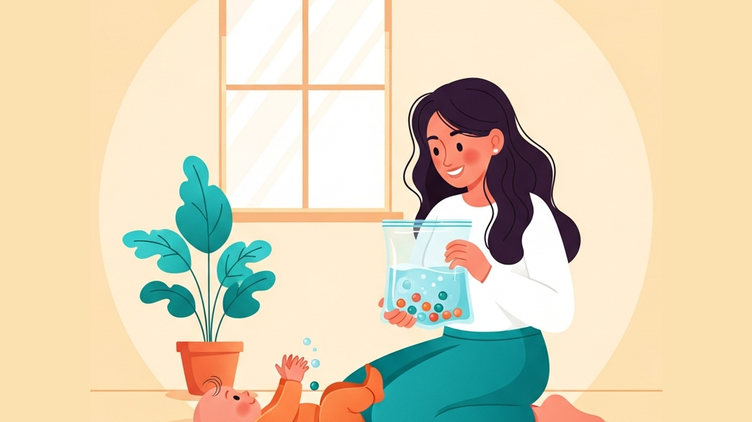
Exploration of the physical world through movement and sensation. Mouthing objects, shaking, dropping, banging, splashing.
Develops: Cause-and-effect reasoning, object permanence, proprioception, fine and gross motor skills, sensory integration.
This is the dominant play type in the first two years and the foundation of all later learning. A baby who has rich sensorimotor experience has more densely connected neural architecture than one who hasn’t — measurable on brain imaging.
Constructive play (1–5 years)
Using materials to build, create, or organize. Blocks, puzzles, drawing, sand and water, clay.
Develops: Spatial reasoning, planning, problem-solving, persistence, creativity.
Constructive play is the most common type across early childhood. It bridges sensorimotor exploration and symbolic play — children move from “what does this do?” to “what can I make with this?”
Symbolic/pretend play (18 months–school age)
Using one thing to represent another, taking on roles, acting out scenarios.
Develops: Symbolic thinking (the foundation of literacy and numeracy — understanding that a mark on paper can represent a sound), theory of mind, narrative structure, emotional processing, language.
The emergence of pretend play around 18 months is one of the most significant cognitive milestones of early childhood. Children who engage in rich pretend play show stronger outcomes in language, reading, math, and social-emotional skills.
Social play (all ages, increasing with age)
Play with others — parallel play (alongside another child, not yet interacting), cooperative play, games with rules.
Develops: Turn-taking, perspective-taking (understanding that others have different thoughts and feelings), negotiation, conflict resolution, cooperation.
Free play vs. guided play
Not all play provides the same developmental benefit. The research distinguishes between:
Free play: Child-initiated, child-directed, with minimal adult structure.
Guided play: Child-initiated, with an adult who follows the child’s lead and adds scaffolding — suggestions, questions, narration — without taking over.
Structured activity: Adult-initiated, adult-directed.
All three have a role. But the balance matters.
Studies comparing guided play to direct instruction for early learning show that guided play produces better outcomes — children learn concepts more deeply, transfer them better to new situations, and maintain higher motivation. This is because guided play preserves the child’s agency and intrinsic motivation while adding the cognitive scaffolding that helps them make meaning.
What doesn’t work well: exclusive direct instruction in early childhood. Young children who are primarily in adult-directed learning situations show lower creativity, lower problem-solving ability, and lower intrinsic motivation than children in play-based environments — even if they perform similarly on narrow knowledge tests initially.
What parents can do to support play-based learning
Provide the materials and step back
The most important thing you can do is make interesting materials available and then let your child direct the interaction.
Good materials for early play:
- Open-ended: blocks, clay, sand, water, fabric, containers
- Not over-specified: a toy that only does one thing requires little thinking; a block can be a car, a phone, a piece of food, a building block
- Appropriately challenging: just above current ability is the sweet spot
Observe before joining
Before inserting yourself into your child’s play, watch for a few minutes. What are they doing? What are they figuring out? What might they need from you — more materials? A question? Silence?
The most common mistake is solving the problem your child is working on before they’ve had a chance to work on it. That interrupts the learning loop.
Add narration, not instruction
When you do engage, narrate what you see rather than directing what should happen:
“You’re trying to make the block stay on top.” “That tower is taller than last time!” “You put all the red ones together.”
This builds metacognition — awareness of their own thinking — without redirecting their play.
Ask open questions
“What would happen if…?” “How are you going to…?” “What are you noticing?”
Not “What color is that?” (closed, testing) but “What do you see?” (open, inviting).
Let them fail
Failure is the most efficient learning mechanism available. When your child’s tower falls, when the piece doesn’t fit, when the plan doesn’t work — their brain is doing exactly what it’s supposed to do. Let the consequence happen. Let them sit in the frustration briefly. The problem-solving that follows is where the learning occurs.
Rescuing a child from every difficulty prevents the development of persistence, frustration tolerance, and problem-solving.
The balance: structure and freedom
Some structure in the day is important for young children. Predictable routines reduce anxiety and cognitive load. Gentle guidance helps children transition between activities.
But the general principle in early childhood education is: the younger the child, the more child-initiated the activity should be.
For a 12-month-old, almost all developmental learning should come through self-directed play with appropriate materials and a responsive caregiver nearby.
For a 3-year-old, some guided play — where an adult adds scaffolding around the child’s self-chosen activity — is developmentally appropriate.
Formal academic instruction — sitting, copying, drilling — is not appropriate before school age and can be actively counterproductive, suppressing intrinsic motivation and narrowing the learning disposition.
A note on screens and “educational” apps
The research on screens in early childhood is consistent: passive screen time does not support the kind of learning that active play provides. A baby watching a counting video does not acquire counting in the same way as a baby sorting objects into containers.
The reason is the learning loop: in play, action produces consequence. The child does something → something happens → they adjust → something different happens. Screen content doesn’t have this loop. It’s observation without action, without adjustment, without consequence.
Interactive apps that require the child’s input and respond to it are closer to play — but the physical contingency, the sensorimotor feedback, and the intrinsic reward of physical mastery are absent.
The screen question for 0–3 is not “educational or not” — it’s “does this replace or supplement active, physical, social play?” If it supplements — fine, in moderation. If it replaces, it’s working against development.
Muchi is built on exactly this principle: every activity is play-based, child-directed, and chosen to match your baby’s developmental stage — not to teach to a test, but to give the brain what it’s actually ready for right now.