Sensory Play for Babies: Why It Matters and How to Start
“Sensory play” has become a parenting buzzword — but the science behind it is real and worth understanding.
Every time a baby squishes a texture, hears an unexpected sound, or watches something move, their brain fires thousands of new neural connections. Sensory experience is literally how a baby’s brain builds itself. The richer and more varied those experiences, the denser the neural architecture.
This guide explains what sensory play actually is, why it works, and how to do it safely at different ages.
What sensory play actually means
Sensory play is any activity that deliberately engages one or more of the senses — touch, sight, sound, smell, taste, balance (vestibular), and proprioception (body position).
Most people think of it as messy play — slime, sand, water. And those are great. But sensory play for young babies looks much simpler: a crinkle toy, a contrasting pattern, a piece of velvet placed in a baby’s palm.
The common thread is intentional sensory input. You’re not just letting a baby encounter the world randomly — you’re curating specific experiences at the right developmental moment.
The neuroscience: why it works
The brain is an experience-dependent organ. Neural pathways are built through use — synapses that fire together wire together.
In the first three years, the brain produces synapses at a rate it will never match again. Sensory experiences drive this production. A baby who has rich, varied sensory experiences in the first 36 months builds a more densely connected brain than one who doesn’t — with measurable effects on cognitive ability, language development, and emotional regulation later.
The window isn’t permanent, but early input has an outsized effect because of how malleable the brain is in these first years.
Age-by-age sensory activities
0–3 months: Vision and touch
At this age, babies can only focus 20–30 cm from their face. Their nervous system is still integrating — too much input at once causes distress, not development.
Best sensory activities:
- Black and white face cards: High-contrast patterns at 20–30 cm stimulate the visual cortex more effectively than anything colorful.
- Texture exploration: Gently place different textures — velvet, terry cloth, a smooth stone — in your baby’s palm and let them feel. Narrate what you’re doing.
- Temperature contrast: Warm your hands, then touch a slightly cool surface to their hand. The contrast sharpens sensory awareness.
What to avoid: Too many stimuli at once. One texture, one sound, one face. Newborn sensory play is slow and minimal.
3–6 months: Movement and cause-and-effect
By three months, babies begin to understand that their actions have effects. This is the foundation of cause-and-effect reasoning, and it transforms how you design sensory play.
Best sensory activities:
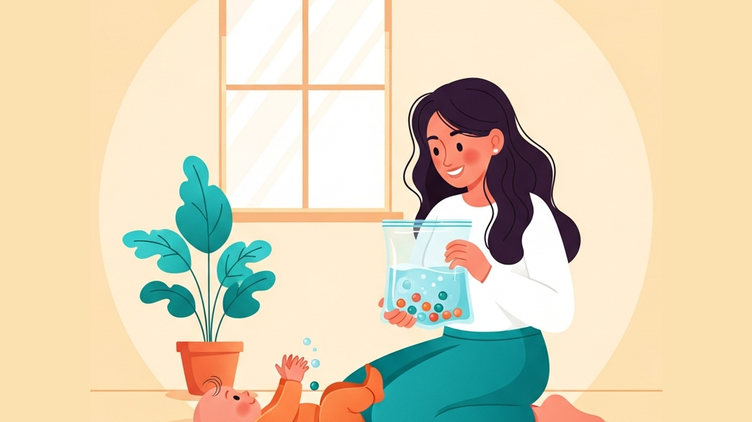
Sensory Water Bag
- Fill a zip-lock bag with water and a few drops of food coloring.
- Seal it tightly and tape it to a flat surface.
- Let your baby press, push, and explore the movement of the water.
- This is mess-free sensory play that develops tactile awareness, fine motor coordination, and cause-and-effect reasoning simultaneously.
Rattling Socks
- Sew or attach small bells to socks and put them on your baby’s feet.
- As they kick — which babies this age do constantly — they hear a sound response.
- This builds the understanding that their own movements create effects in the world.
Bubble Bath
- Let your baby touch and pop bubbles (under close supervision, in safe water depth).
- The combination of water temperature, tactile sensation, and visual tracking is rich sensory input.
6–12 months: Exploration and object permanence
At six months, babies can sit supported and reach with intention. Their hands are now tools for exploration. This is the age of putting everything in their mouth — which is developmentally appropriate; the mouth has the highest concentration of sensory receptors in the body.
Best sensory activities:
Magic Cloth Box
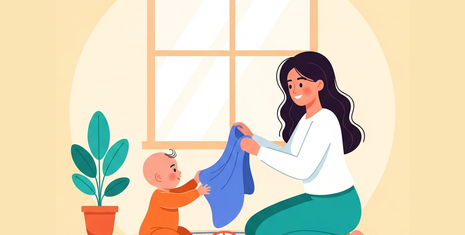
- Fill a box or container with different fabric scraps — velvet, mesh, toweling, silk.
- Let your baby pull them out, feel them, and drop them.
- This develops object permanence (when a cloth disappears into the box, it still exists), grip strength, and tactile discrimination.
Spoon Drumming
- Give your baby a wooden spoon and a series of containers — metal bowl, plastic container, cardboard box.
- Let them bang and discover how different surfaces make different sounds.
- This is auditory sensory play: the brain is mapping the relationship between force, material, and sound.
Soft Blocks
- Fabric blocks with different textures, sounds, and weights on each face.
- Encourage stacking, dropping, squeezing.
- The unpredictability of how they fall develops spatial reasoning.
12–24 months: Messy play and independence
Toddlers have both the motor skills and the cognitive capacity for true messy play. This is the age when sensory play expands to sand, clay, water transfer, and paint.
Best sensory activities:
Sand Tray
- A shallow tray filled with kinetic sand or regular sand.
- Let your toddler pour, scoop, trace patterns.
- The proprioceptive feedback from pressing into sand is deeply regulating for the nervous system — it’s why many children with sensory sensitivities respond well to it.
Colorful Water Pouring
- Two containers, colored water, measuring cups and spoons.
- Let your toddler pour, fill, and empty repeatedly.
- This develops fine motor control, volume concepts, and — through the mess — a tolerance for imperfection.
Homemade Dough
- Mix 1 cup flour, ½ cup salt, ½ cup water, 1 tbsp oil.
- Let your toddler help mix it, then play with the result.
- The process of making the dough is itself sensory play.
24–36 months: Complexity and creativity
By two years, sensory play can incorporate problem-solving, creativity, and narrative. Your child isn’t just experiencing textures — they’re building with them, sorting them, telling stories about them.
Best sensory activities:
Color Sorting Game
- Mixed colored objects (blocks, pompoms, buttons) and color-coded containers.
- Sorting by color is cognitive classification play, but the visual and tactile engagement makes it sensory too.
Treasure Hunt in Ice
- Freeze small toys or objects in a block of ice.
- Give your toddler warm water, a dropper, and small tools to excavate them.
- The temperature contrast, the physical effort, and the anticipation are all sensory experiences.
Nature Treasure Hunt
- A bag and a garden or park.
- Collect leaves (smooth, rough, crinkly), pebbles, sticks, petals.
- Sort by texture when you get home.
- This connects sensory play to the natural world and develops scientific observation.
Setting up sensory play safely
A few principles that matter:
Size: Nothing smaller than a 35mm cylinder should be in reach of babies and toddlers. If it fits inside a toilet roll tube, it’s a choking hazard.
Supervision: Sensory water play and small object play always need an adult present.
Allergies: If you’re using food-based materials (flour, oats, pasta), make sure there are no known allergies or intolerances. Introduce any new material slowly.
Sensory sensitivity: Some children — particularly those with autism or sensory processing differences — may be averse to certain textures or highly reactive to unexpected input. Start with lower-intensity sensory experiences and follow the child’s lead.
Reading your child’s sensory signals
Children self-regulate sensory input when they can. Watch for:
Engaged: Reaching toward the material, calm face, focused attention, returning to the activity after a break.
Dysregulated: Pulling away, crying, shoving material aside, hitting, seeking escape. These aren’t “bad behavior” — they’re a child whose sensory system is overloaded.
Never force sensory play. The goal is exploration, not exposure.
Sensory play is woven through every age group in Muchi. The app recommends activities based on your child’s exact age in months — so you always know what’s developmentally appropriate, and what materials you need.